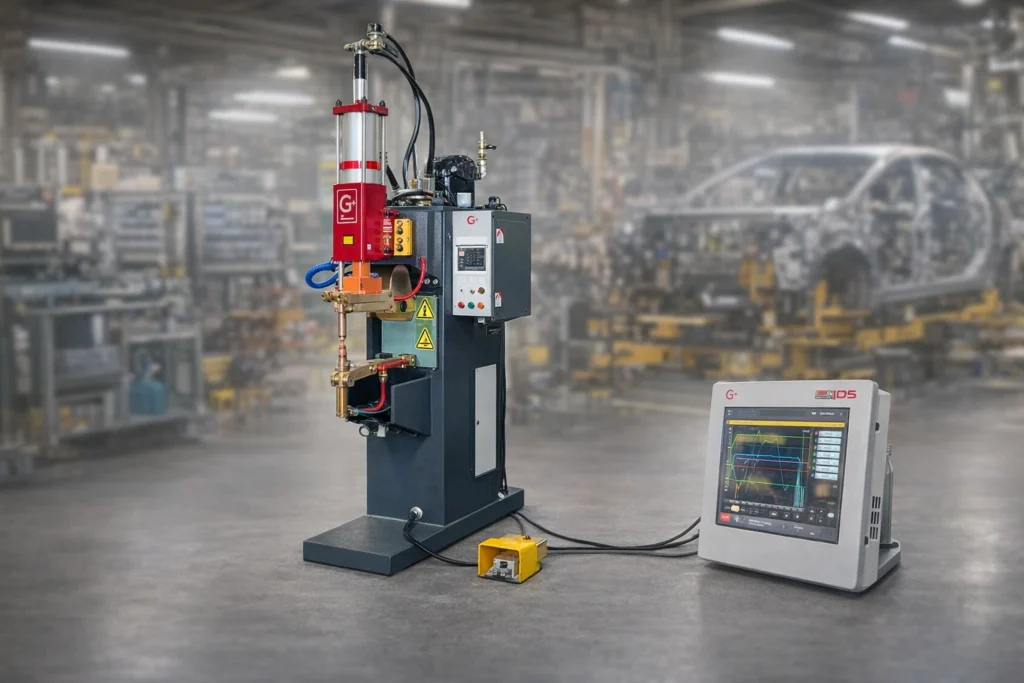

Electric resistance welding (ERW) is a cornerstone technology in modern manufacturing, enabling fast, precise, and reliable metal joining across industries. From automotive assembly lines to heavy machinery production, ERW offers a combination of speed, strength, and repeatability that makes it indispensable for OEMs, manufacturing engineers, and automation integrators. In this guide, we’ll explore the principles, applications, comparisons, and best practices of electric resistance welding, while highlighting how Heron Welder delivers advanced solutions tailored to industrial needs.
What is Electric Resistance Welding?
Electric resistance welding is a metal-joining process that uses heat generated by electrical resistance to fuse metal surfaces together. Unlike traditional welding methods that rely on external heat sources or filler materials, ERW leverages controlled electric currents and mechanical pressure to create strong, consistent welds.
How ERW Works
- Preparation: Metal surfaces are cleaned and positioned precisely.
- Current Application: A high-amperage electric current passes through the metal at the contact point.
- Resistance Heating: The metal’s natural electrical resistance generates localized heat.
- Pressure Application: Mechanical force is applied, pressing the heated surfaces together.
- Cooling: The weld solidifies under pressure, forming a durable joint.
The process can be executed in various formats, including spot welding, projection welding, seam welding, and capacitor discharge welding, depending on the material type, thickness, and production speed requirements.
Key Applications of Electric Resistance Welding
Electric resistance welding is highly versatile and widely used in industrial manufacturing. Typical applications include:
Automotive Industry
ERW is extensively applied in vehicle body assembly, joining sheet metal panels, chassis components, and structural frames. Its speed and precision make it ideal for high-volume production lines.
Electrical and Electronics Manufacturing
For products such as battery tabs, connectors, and terminals, ERW provides consistent, low-heat welds that prevent component damage.
Metal Fabrication and Structural Applications
ERW is used to create tubes, pipes, and structural components in construction, heavy machinery, and industrial equipment manufacturing, ensuring strong and uniform welds.
Appliance and Consumer Goods
From refrigerators to washing machines, ERW is employed to assemble sheet metal parts efficiently while maintaining aesthetic quality.
Benefits of Electric Resistance Welding
ERW offers several advantages over other welding methods:
- Speed and Efficiency: High-speed production without the need for filler materials.
- Consistent Quality: Precise control of current and pressure ensures uniform welds.
- Energy Efficiency: Localized heating reduces energy consumption compared to arc welding.
- Automation Friendly: Easily integrated into automated production lines for high-volume manufacturing.
- Material Flexibility: Suitable for various metals, including steel, aluminum, and alloys.
Comparing Electric Resistance Welding with Other Methods
| Feature | Electric Resistance Welding | Arc Welding | Laser Welding |
|---|---|---|---|
| Heat Source | Electrical resistance | Electric arc | Focused laser |
| Speed | Very high | Moderate | High |
| Filler Material | Not required | Often required | Sometimes required |
| Automation | Easily automated | Moderate | High |
| Material Thickness | Thin to medium | Thin to thick | Thin to medium |
| Production Volume | High-volume production | Low-to-medium | Medium-to-high |
ERW stands out for high-volume, repetitive applications where speed, precision, and automation integration are critical.
Best Practices for Electric Resistance Welding
To maximize efficiency and weld quality, manufacturers should follow these best practices:
- Surface Preparation: Clean, oxide-free surfaces reduce resistance inconsistencies.
- Proper Electrode Selection: Use electrodes suitable for the material type and thickness.
- Current and Pressure Control: Calibrate welding parameters precisely to avoid under- or over-welding.
- Regular Maintenance: Keep electrodes and machines well-maintained for consistent performance.
- Automation Integration: Implement ERW machines with programmable controls for optimized production flow.
Heron Welder’s resistance welding machines and automation solutions are designed to adhere to these best practices, ensuring superior weld quality and operational efficiency for manufacturers.
Why Choose Heron for Electric Resistance Welding Solutions?
As a global leader in industrial welding and metal-joining equipment, Heron Welder offers:
- Advanced ERW Machines: Spot, projection, seam, MFDC, and capacitor discharge welding machines designed for diverse industrial needs.
- Automation Integration: Customizable solutions that seamlessly integrate into automated production lines.
- Global Support: Engineering expertise and technical support for OEMs, manufacturing engineers, and integrators.
- Quality and Reliability: GMP-grade machines built for precision, durability, and consistent performance.
Whether you require high-volume automotive spot welding or precision capacitor discharge welding for electronics, Heron provides tailored solutions to optimize production, reduce downtime, and ensure superior weld quality.
FAQs About Electric Resistance Welding
1. Can ERW be used for both thin and thick metals?
Yes, ERW is versatile and can join a range of material thicknesses, though process type and welding parameters must be adapted accordingly.
2. What metals are suitable for electric resistance welding?
Common metals include steel, stainless steel, aluminum, and various alloys. Conductivity and material thickness influence parameter settings.
3. How does ERW compare to laser welding in production?
ERW is more energy-efficient for high-volume, repetitive tasks, while laser welding offers precision for complex or delicate components.
4. Is ERW suitable for automation?
Absolutely. ERW machines are easily integrated with robotic arms, conveyors, and PLC-controlled production lines for fully automated manufacturing.
5. How do I maintain consistent weld quality?
Regular electrode maintenance, surface preparation, and precise calibration of current and pressure are essential for repeatable results.
Conclusion
Electric resistance welding is a fast, efficient, and reliable metal-joining solution for modern industrial manufacturing. Its compatibility with automation, high production volumes, and wide range of applications make it a strategic choice for OEMs and manufacturing engineers.
Heron Welder combines cutting-edge ERW machines with engineering expertise, helping manufacturers achieve superior weld quality, operational efficiency, and production flexibility.
Request a quote today or consult with Heron for a customized electric resistance welding solution that perfectly fits your manufacturing needs.