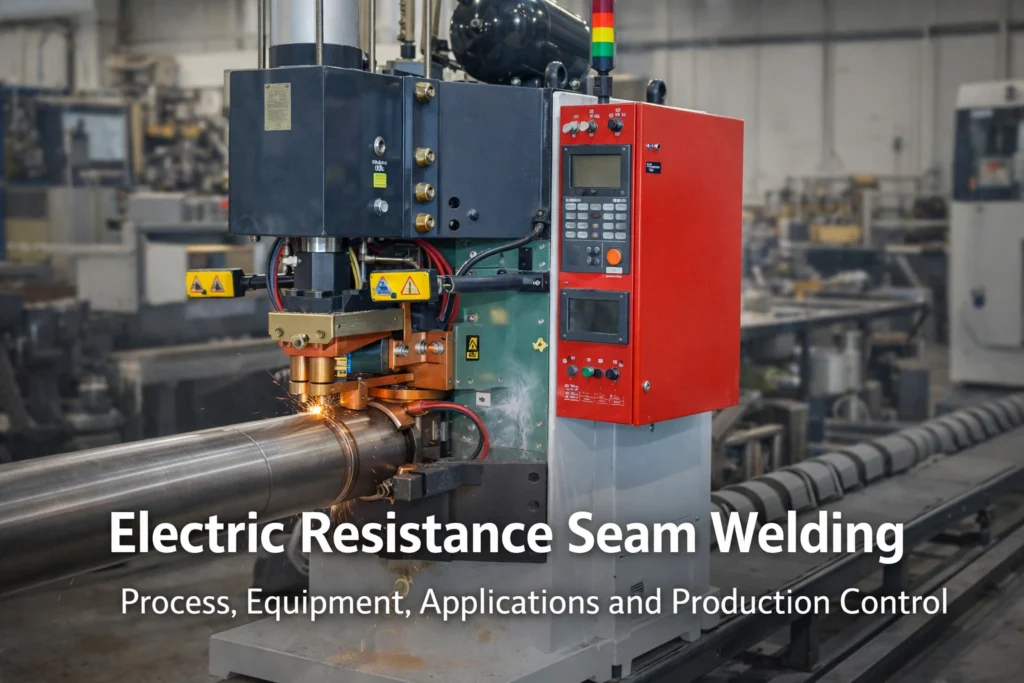

Electric resistance welding (ERW) is a cornerstone of modern manufacturing, providing efficient, high-speed metal joining for industries ranging from automotive and aerospace to appliance and heavy machinery production. For engineers, OEMs, and factory decision-makers, understanding the principles, applications, and advantages of ERW is crucial for selecting the right welding solutions that deliver precision, repeatability, and operational efficiency.
At Heron Welder, we specialize in delivering advanced resistance welding machines, controllers, and automated production systems designed to meet the exacting demands of industrial manufacturers worldwide.
What is Electric Resistance Welding?
Electric resistance welding is a metal-joining process in which heat generated by electrical resistance is used to fuse two or more metal components. Unlike traditional welding methods, ERW does not require filler materials, flux, or shielding gases. Instead, it relies on the controlled flow of electric current and applied pressure to create a strong, consistent weld.
The process can be broadly classified into several types:
- Spot Welding: Joins metal sheets at localized points using electrodes.
- Projection Welding: Concentrates current at pre-formed projections on one of the workpieces.
- Seam Welding: Creates continuous welds along the length of the workpiece using rotating wheel electrodes.
- MFDC (Medium-Frequency Direct Current) Welding: Provides precise control for thin sheets and dissimilar metals.
- Capacitor Discharge Welding: Delivers extremely fast, high-current pulses for small components.
Each method is engineered to optimize production speed, minimize energy consumption, and maintain weld quality.
How Electric Resistance Welding Works
At the core of ERW lies Joule heating, the principle where electrical resistance converts current into heat. The process typically follows these steps:
- Clamping: The metal pieces are held firmly between copper electrodes.
- Current Flow: A controlled electrical current passes through the contact area, generating heat.
- Pressure Application: Simultaneously, the electrodes apply pressure to forge the metals together.
- Cooling: The weld solidifies under continued pressure to form a robust joint.
The precise synchronization of current, pressure, and timing is critical. Modern welding controllers, like those offered by Heron, allow engineers to fine-tune these parameters for consistent, high-quality results across production lines.
Applications of Electric Resistance Welding
Electric resistance welding is versatile and widely adopted in industries where high-volume, repeatable, and precise welding is required:
- Automotive Manufacturing: Spot and projection welding are used to assemble car bodies, frames, and structural components.
- Appliance Production: Seam and spot welding join sheet metal in refrigerators, washing machines, and ovens.
- Electrical & Electronics: Capacitor discharge welding is ideal for battery tabs, connectors, and micro-components.
- Aerospace & Heavy Equipment: MFDC welding ensures high-strength, defect-free joints in critical structural parts.
By leveraging ERW, manufacturers can achieve faster cycle times, reduced labor costs, and uniform weld quality, which directly impacts production efficiency and product reliability.
Electric Resistance Welding vs. Other Welding Methods
Choosing ERW over alternative welding techniques requires understanding its strengths and limitations:
| Welding Type | Advantages | Considerations |
|---|---|---|
| ERW | Fast, precise, no filler material, highly repeatable | Limited to metals with good conductivity, requires electrode maintenance |
| MIG Welding | Flexible, works on thicker sections, visually inspectable | Slower for high-volume production, requires shielding gas |
| TIG Welding | High-quality, clean welds on thin metals | Lower speed, more operator skill required |
| Laser Welding | Extremely precise, low heat input | High equipment cost, complex setup |
For high-volume, automated production, ERW often outperforms manual or gas-based methods, particularly when integrated with automated welding lines and intelligent controllers.
Best Practices for Electric Resistance Welding
To maximize ERW performance and weld quality, manufacturers should consider:
- Electrode Maintenance: Regular cleaning and dressing prevent inconsistent welds and reduce downtime.
- Parameter Optimization: Adjust current, pressure, and welding time for each material and thickness.
- Material Preparation: Ensure clean, oxide-free surfaces for optimal conductivity.
- Automated Monitoring: Utilize advanced controllers for real-time process feedback and consistency.
- Operator Training: Skilled operators are essential for setup, troubleshooting, and quality assurance.
Heron Welder provides tailored resistance welding solutions, combining precision machinery with intelligent controls to ensure these best practices are embedded in every production setup.
Why Partner with Heron for Electric Resistance Welding
Heron Welder has over two decades of experience in industrial welding automation, supplying OEMs and factories with:
- Spot, projection, and seam welders
- MFDC and capacitor discharge systems
- Self-pierce riveting (FSPR) and clinching machines
- Automated welding production lines with integrated controllers
Our systems are designed to maximize throughput, minimize defects, and support high-volume manufacturing. By combining robust machinery with expert application support, Heron ensures manufacturers achieve consistent, high-quality welds while optimizing operational efficiency.
Frequently Asked Questions (FAQs)
1. What metals can be welded using electric resistance welding?
ERW works best on conductive metals such as steel, stainless steel, aluminum, and copper alloys. Thin sheets and dissimilar metals may require specialized controllers.
2. How does ERW compare in speed to MIG or TIG welding?
ERW, especially spot and seam welding, is much faster and suitable for high-volume production, while MIG/TIG are better for specialized or thicker joints.
3. Is ERW suitable for automated production lines?
Absolutely. ERW is ideal for automation due to its repeatable cycle, quick weld times, and compatibility with robotic welding systems.
4. How can I ensure consistent weld quality?
Regular electrode maintenance, precise parameter control, and real-time monitoring are critical. Heron’s controllers and automation solutions simplify this process.
5. Can ERW handle complex shapes?
Yes, with proper tooling and electrode design, ERW can accommodate a range of geometries from flat sheets to tubular components.
Take Your Manufacturing to the Next Level
Electric resistance welding offers unmatched speed, efficiency, and consistency for high-volume production. Partnering with Heron Welder means accessing advanced ERW machinery, automated solutions, and expert support to optimize your operations.
Request a quote or consult with our team today to explore customized welding and automation solutions tailored to your factory’s unique needs.