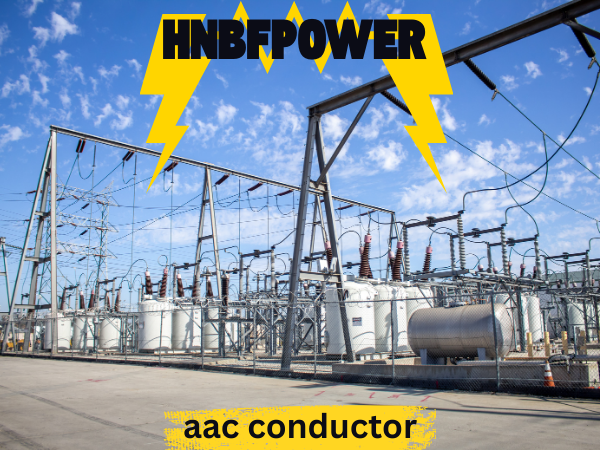

In modern power transmission and distribution projects, selecting the right conductor directly affects network reliability, installation efficiency, and long-term operating cost. Among the most widely used solutions for short- to medium-span overhead lines, the AAC conductor (All Aluminum Conductor) remains a proven and cost-effective option for utilities, EPC contractors, and grid infrastructure developers.
As a global manufacturer of overhead conductors and power cables, HNBF Power supplies high-quality AAC conductors designed to meet the technical and commercial expectations of international power projects, from urban distribution networks to renewable energy interconnections.
This guide explains how AAC conductor works, where it performs best, and how engineers and procurement teams can specify it correctly for real-world utility applications.
What Is an AAC Conductor?
An AAC conductor is made entirely of stranded aluminum wires, typically produced from high-purity electrical grade aluminum. Unlike composite conductors such as ACSR or AAAC, AAC contains no steel or alloy core.
Key Construction Characteristics
- Multiple strands of hard-drawn aluminum wire
- Circular stranded construction
- Lightweight and flexible for easier installation
- Designed for overhead transmission and distribution lines
Because aluminum has excellent electrical conductivity, AAC conductors provide very low electrical resistance for a given cross-section.
Why Utilities Still Choose AAC Conductor
High Electrical Conductivity
AAC conductor offers higher conductivity than many alloy-based alternatives. This allows utilities to achieve:
- Lower line losses
- Improved current-carrying efficiency
- Better performance in short-span and low-sag requirements
For distribution networks operating at low and medium voltage, AAC remains highly competitive.
Lightweight Design for Easier Installation
The absence of a steel core significantly reduces overall conductor weight. This is especially valuable for:
- Urban and suburban overhead distribution projects
- Pole-mounted networks
- Short-route interconnections and service extensions
Lower weight simplifies stringing operations and reduces mechanical load on poles and crossarms.
Typical Applications of AAC Conductor
AAC conductor is mainly used in overhead power distribution and light transmission applications where mechanical loading is moderate and high conductivity is the primary requirement.
Common Utility Use Cases
- Overhead distribution lines in cities and residential areas
- Industrial parks and commercial zones
- Renewable energy collection systems with short spans
- Coastal and corrosion-sensitive environments
Due to its aluminum construction, AAC conductor also demonstrates strong resistance to atmospheric corrosion, making it suitable for coastal or humid regions.
Mechanical Performance Considerations
While AAC conductor performs exceptionally well electrically, it has lower tensile strength compared to reinforced conductors such as ACSR.
Important Engineering Factors
- Lower mechanical strength limits long-span applications
- Higher sag under heavy loading compared to steel-reinforced conductors
- Best suited for short to medium spans
For projects involving river crossings, mountain terrain, or long span transmission structures, utilities often prefer AAAC or ACSR. However, for compact distribution systems, AAC remains highly efficient and economical.
AAC Conductor Standards and Specifications
When specifying AAC conductor for utility tenders and EPC projects, compliance with recognized international standards is critical.
Commonly Referenced Standards
- ASTM standards for all aluminum conductors
- IEC conductor construction requirements
- BS specifications for stranded aluminum conductors
At HNBF Power, AAC conductors are manufactured with strict control of:
- Aluminum purity and mechanical properties
- Strand diameter and lay length
- Electrical resistance and conductivity
- Surface quality and dimensional consistency
This ensures stable performance during installation and throughout the service life of the overhead line.
How to Select the Right AAC Conductor Size
Conductor Cross-Section and Ampacity
Engineers should calculate conductor size based on:
- Required current-carrying capacity
- Ambient temperature
- Wind and solar heating conditions
- Allowable conductor temperature rise
Mechanical Loading and Sag Design
Proper sag-tension analysis is essential to confirm:
- Maximum allowable span length
- Pole and structure loading limits
- Clearance requirements
For procurement teams, verifying conductor data such as rated tensile strength, unit weight, and DC resistance is essential before final approval.
HNBF Power supports utilities and EPC partners by providing detailed technical datasheets and project-specific conductor recommendations.
AAC Conductor vs ACSR and AAAC
AAC vs ACSR
- AAC offers better conductivity
- ACSR offers much higher mechanical strength
- ACSR is better for long spans and heavy mechanical loading
AAC vs AAAC
- AAC has slightly higher conductivity
- AAAC provides better tensile strength and reduced sag
- AAAC is preferred for longer distribution spans
For many distribution networks, AAC remains the most cost-effective solution when mechanical strength requirements are moderate.
Manufacturing and Quality Control at HNBF Power
As a global manufacturer of overhead conductors, HNBF Power produces AAC conductor using advanced stranding equipment and continuous quality monitoring.
Our production process focuses on:
- Stable aluminum wire drawing quality
- Precise stranding geometry
- Electrical resistance testing
- Mechanical strength verification
- Dimensional and surface inspection
This ensures every AAC conductor delivered to utilities and EPC contractors meets project specifications and international standards.
FAQs – AAC Conductor
1. What does AAC conductor stand for?
AAC conductor stands for All Aluminum Conductor, meaning the conductor is made entirely from stranded aluminum wires without any steel or alloy core.
2. Is AAC conductor suitable for high-voltage transmission lines?
AAC conductor is generally recommended for distribution networks and short-span transmission lines. For long spans and heavy mechanical loading, reinforced conductors such as ACSR are more suitable.
3. Does AAC conductor perform well in coastal areas?
Yes. Due to its aluminum construction and corrosion resistance, AAC conductor performs well in coastal and humid environments.
4. How does AAC conductor compare in terms of cost?
AAC conductor is usually more economical than alloy or reinforced conductors when mechanical requirements are moderate, making it attractive for large-scale distribution projects.
5. Can HNBF Power customize AAC conductor specifications?
Yes. HNBF Power can customize conductor size, stranding construction, packaging, and compliance standards based on project and utility requirements.
Partner with HNBF Power for Your AAC Conductor Projects
Selecting the right AAC conductor is not only a technical decision it is a strategic investment in long-term network reliability and installation efficiency.
Whether you are planning a new distribution network, upgrading aging overhead lines, or executing large EPC utility projects, HNBF Power provides reliable AAC conductor solutions backed by global manufacturing capability and professional technical support.
Contact HNBF Power today to discuss your project requirements and receive customized AAC conductor solutions tailored for your power transmission and distribution needs.