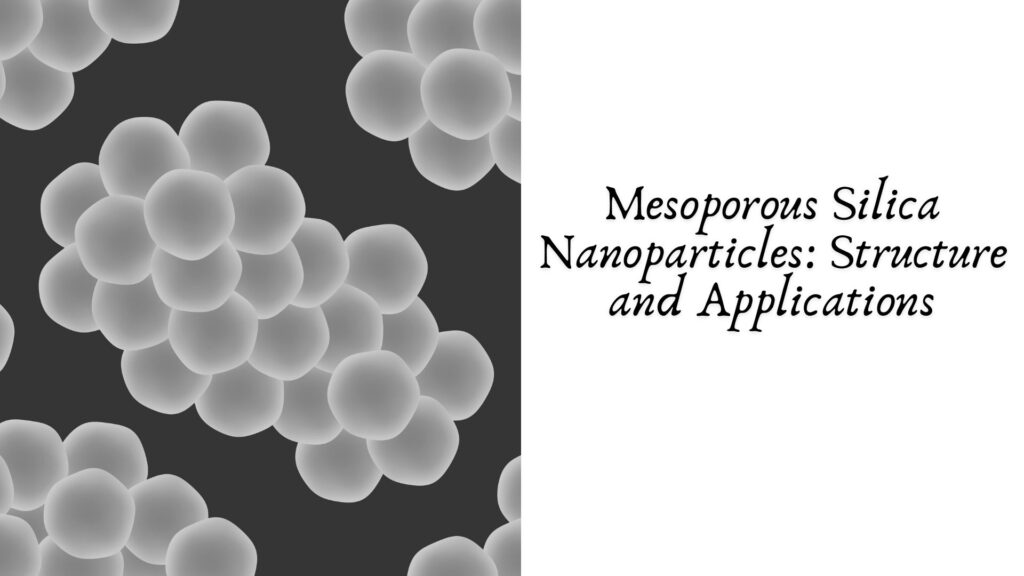

Introduction to Mesoporous Silica Nanoparticles (MSNs)
Mesoporous silica nanoparticles (MSNs) are a class of advanced nanomaterials characterized by their highly ordered pore structures, large surface area, and tunable pore sizes ranging from 2 to 50 nanometers. These features place them within the mesoporous category, distinguishing them from microporous and macroporous materials.
Over the past two decades, MSNs have attracted significant attention in fields such as drug delivery, catalysis, environmental science, and energy storage. Their versatility stems from their unique structural properties and the ability to functionalize their surfaces with a wide variety of chemical groups.
Understanding the Structure of MSNs
Core Framework
Mesoporous silica nanoparticles are primarily composed of silicon dioxide (SiO₂), forming a robust and stable framework. The structure consists of:
- Siloxane bonds (Si–O–Si): Provide mechanical strength and stability
- Silanol groups (Si–OH): Present on the surface, enabling chemical modification
This combination allows MSNs to maintain structural integrity while offering flexibility for functionalization.
Ordered Mesoporous Architecture
The defining feature of MSNs is their ordered pore arrangement, which can take several forms:
- Hexagonal arrays (e.g., MCM-41): Uniform cylindrical pores
- Cubic structures (e.g., MCM-48): Three-dimensional interconnected pores
- Lamellar structures: Layered arrangements
These pore systems allow efficient diffusion of molecules, making MSNs highly suitable for applications requiring controlled transport.
High Surface Area and Pore Volume
MSNs exhibit:
- Surface areas often exceeding 1000 m²/g
- Large pore volumes that enable high loading capacity
These characteristics are essential for applications such as adsorption, catalysis, and drug encapsulation.
Tunable Pore Size and Particle Morphology
One of the most important advantages of MSNs is their tunability:
- Pore size can be adjusted by changing synthesis conditions or templates
- Particle size and shape (spherical, rod-like, hollow) can be controlled
This flexibility enables customization for specific applications.
Synthesis of Mesoporous Silica Nanoparticles
MSNs are typically synthesized using templating methods, where surfactants guide pore formation.
Common Synthesis Techniques:
- Sol-gel method: Hydrolysis and condensation of silica precursors
- Soft templating: Uses surfactants like CTAB to create pore structures
- Hard templating: Uses solid templates for precise architectures
The removal of templates (via calcination or extraction) leaves behind a porous silica framework.
Key Properties of MSNs
Mesoporous silica nanoparticles possess several unique properties:
- Biocompatibility: Suitable for biomedical use
- Thermal stability: Resistant to high temperatures
- Chemical inertness: Stable in various environments
- Easy functionalization: Surface can be modified with organic or inorganic groups
- Controlled release capability: Ideal for drug delivery systems
Applications of Mesoporous Silica Nanoparticles
Drug Delivery Systems
MSNs are widely used in biomedical applications due to their ability to:
- Load large quantities of drugs
- Protect drugs from degradation
- Enable controlled and targeted release
They are especially promising in cancer therapy, where functionalized MSNs can target specific cells and reduce side effects.
Catalysis
MSNs serve as excellent catalyst supports because of:
- High surface area for active sites
- Uniform pore structure for reactant access
- Ability to anchor metal nanoparticles or enzymes
They are used in both industrial and laboratory-scale catalytic processes.
Environmental Applications
In environmental science, MSNs are used for:
- Water purification: إزالة heavy metals and organic pollutants
- Air filtration: Capture of harmful gases
- Adsorption of dyes and toxins
Their porous structure enhances adsorption efficiency significantly.
Energy Storage and Conversion
MSNs contribute to energy technologies by:
- Acting as supports in batteries and supercapacitors
- Enhancing electrode performance
- Improving stability and conductivity when combined with other materials
Sensors and Imaging
MSNs are also used in:
- Biosensors: Detecting biomolecules and pathogens
- Imaging: Serving as carriers for fluorescent dyes or contrast agents
- Diagnostics: Early disease detection
Advantages of Mesoporous Silica Nanoparticles
- Highly customizable structure
- Excellent loading capacity
- Stable under harsh conditions
- Versatile across multiple industries
- Cost-effective synthesis methods
Challenges and Limitations
Despite their benefits, MSNs face some challenges:
- Potential toxicity concerns at high concentrations
- Complex synthesis optimization
- Scalability issues for industrial production
- Surface modification stability over time
Ongoing research aims to address these limitations and improve performance.
Future Perspectives
The future of mesoporous silica nanoparticles is highly promising. Emerging trends include:
- Smart drug delivery systems with stimuli-responsive release
- Hybrid nanomaterials combining MSNs with polymers or metals
- Green synthesis approaches for sustainability
- Advanced applications in nanomedicine and personalized therapy
As research progresses, MSNs are expected to play a critical role in advancing nanotechnology and solving global challenges in healthcare, energy, and environmental protection.
Conclusion
Mesoporous silica nanoparticles represent a powerful class of nanomaterials with unique structural characteristics and broad application potential. Their ordered pore systems, high surface area, and tunable properties make them indispensable in modern science and technology.
From targeted drug delivery to environmental remediation and energy storage, MSNs continue to revolutionize multiple industries. With ongoing advancements in synthesis and functionalization, their impact is set to grow even further in the coming years.